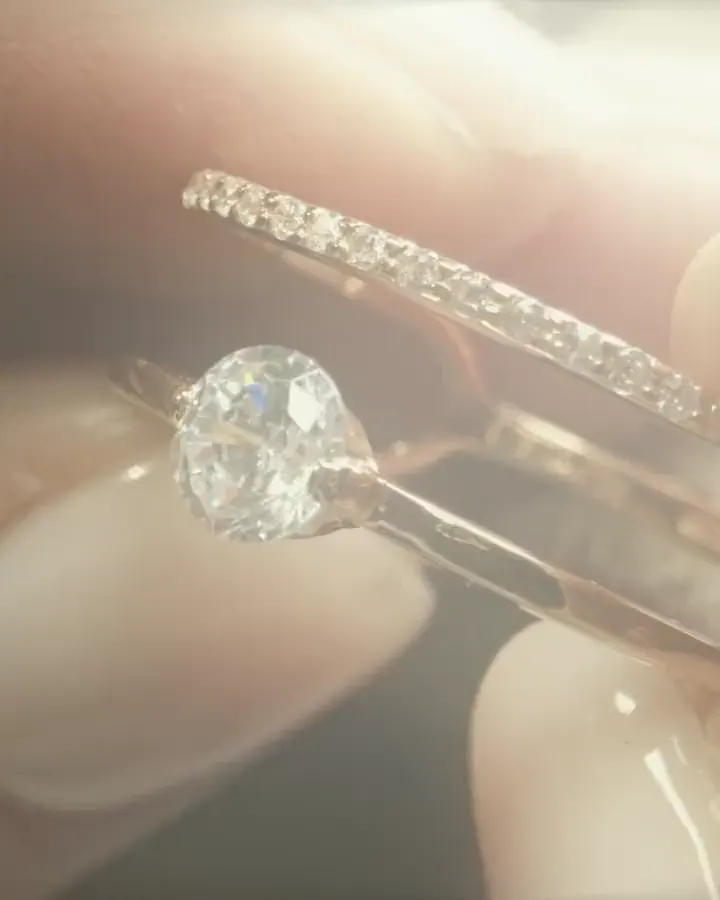
Lab grown vs natural diamonds is the first question most couples ask when they sit down at our tray on West 47th Street. The short answer: both are real diamonds, made of the same carbon crystal. One grew deep in the earth over a very long time. The other grew in a lab over a few weeks. What changes is the price, the paperwork and how the stone holds value, not how it looks on your hand.
What is the same
A lab grown diamond and a natural diamond are the same material. Both are pure carbon arranged in a cubic crystal. Both score 10 on the Mohs hardness scale, which is why both can be worn every day for a lifetime. Both bend and split light the same way, so the sparkle you see under the showroom lights or by the window comes from the same physics.
That means the things you can see are graded the same way too. Cut, color, clarity and carat weight describe a lab diamond just as they describe a mined one. If you want a refresher, our plain words guide to the 4Cs walks through each one.
- Same chemistry: carbon.
- Same hardness: 10 on the Mohs scale.
- Same fire and brilliance when cut well.
- Same settings, metals and ring sizing.
What is different
The real differences are origin, price and resale. A natural diamond formed underground and was mined. A lab grown diamond was grown above ground from a small diamond seed, using one of two methods called CVD and HPHT. Our page on CVD vs HPHT explains both without the jargon.
Because a lab can grow diamonds to order, supply is not limited the way mined supply is. That is the main reason a lab grown diamond usually costs a fraction of a mined diamond of the same size and grade. As a rough guide, many buyers find they can go up in carat weight, or up in color and clarity, for the same budget.
The other side of that coin is resale. Lab grown diamond prices have kept falling as growing gets easier, so a lab stone is worth far less on the secondhand market than what you paid. We cover this honestly on our lab grown diamond resale value page. Buy a lab diamond to wear and enjoy, not as an investment.
Can you tell them apart by eye?
No. Not by eye, and not with a regular jeweler’s loupe. A trained gemologist with a standard loupe sees the same kinds of crystals and feathers inside both. Telling them apart takes lab equipment that reads how the crystal grew and what trace elements it holds.
This is why the grading report matters so much. Every lab grown center stone we offer comes with an IGI or GIA report that says, in plain print, that the diamond is laboratory grown. Most lab diamonds also carry a tiny laser inscription on the girdle, the thin edge around the stone, with the report number. At the showroom we put the stone under the loupe so you can read that inscription yourself and match it to the paper. Read more in our guide to IGI certified lab grown diamonds.
How the choice plays out on a real budget
Here is how the decision usually goes at our tray. A couple comes in with a budget in mind and a shape they love, say an oval. With a mined stone, that budget may buy a smaller diamond, or a larger one with lower color. With a lab grown diamond, the same budget often reaches a bigger stone with whiter color and cleaner clarity, plus a nicer setting.
Some people still choose mined. They like the idea of a stone that formed in the earth, or they care about long term value. That is a fair reason, and we will tell you so. Others choose lab grown because they would rather put the money toward a size they love, a platinum band, or the honeymoon. Neither choice is wrong. The goal is that you know what you are paying for.
| Question | Lab grown diamond | Natural diamond |
|---|---|---|
| Is it a real diamond? | Yes, carbon crystal | Yes, carbon crystal |
| Hardness | 10 on Mohs | 10 on Mohs |
| Where it formed | Grown in a lab | Formed underground, mined |
| Typical price for the same grade | Much lower | Much higher |
| Resale value | Low | Higher, though below retail |
| Grading report | IGI or GIA, marked laboratory grown | GIA, IGI and others |
Questions to ask any jeweler
Whether you buy from us or someone else on 47th Street, these questions keep the conversation honest:
- Is this stone lab grown or natural, and does the report say so?
- Which lab issued the report, and can I see the report number on the stone?
- Is the price for the stone alone, the setting alone, or the finished ring?
- What metal is the setting, and is it 14k, 18k or platinum?
- Can I see two or three stones of the same shape side by side before I choose?
A good answer to every one of these should come quickly and in writing. If it does not, slow down.
Seeing both in person on 47th Street
Photos online are a starting point, but a diamond is a thing you need to see move. In our showroom at 30 West 47th Street, Suite 806, we lay out stones on a tray and let you turn them under the light and by the window. You can compare shapes, look through the loupe, and try settings on your own hand.
If you already know roughly what you want, tell us before you come. Our loose lab grown diamonds page lets you request stones by shape, carat, color, clarity and budget. We pull 3 to 5 matching stones and have them on the tray when you arrive. If you are still choosing a style, browse our lab grown diamond engagement rings first and save the ones you like.
When you are ready, book a viewing or call us at (212) 642-4345. Viewings are by appointment, so the stones are out and the time is yours.
Viewings by appointment. Tell us what you would like to see and we will have it out on the tray.
Book a viewingOr call (212) 642-4345