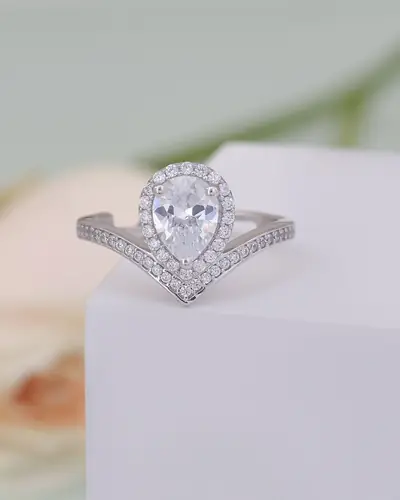
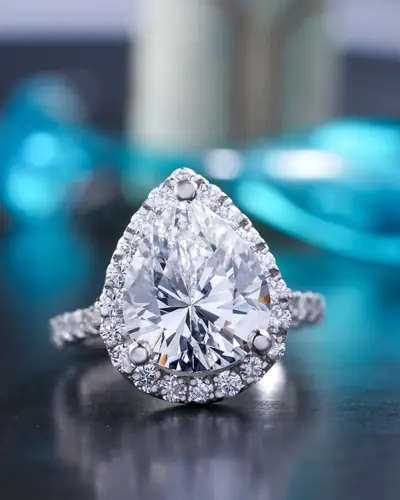
A pear shaped lab grown diamond is rounded at one end and pointed at the other, a teardrop that looks graceful and generous on the hand. Browse pear solitaires, halos and toi et moi rings with starting prices, then book a viewing to compare outlines and bow ties in person.
No pieces match those filters. Clear one, or call (212) 642-4345 and we will tell you what is in the showroom.
Starting prices. Your final price depends on the diamond you choose.
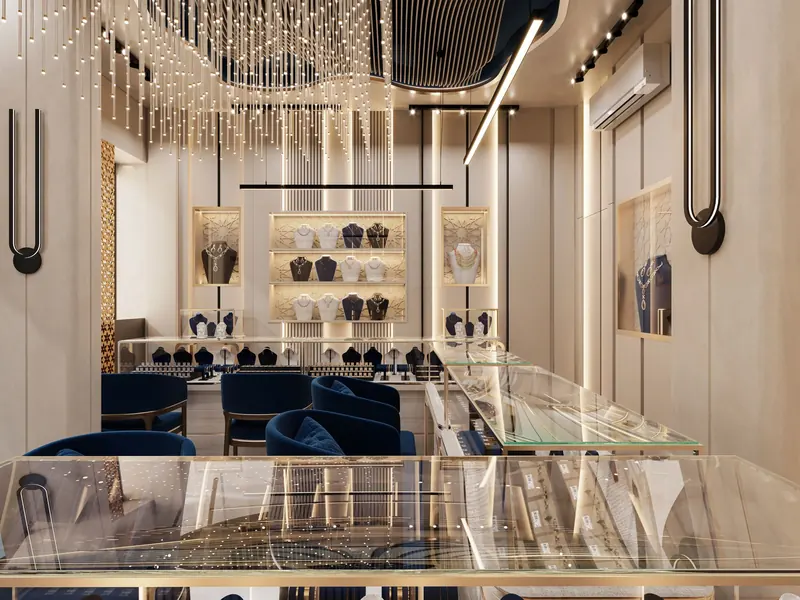
There is no cart here. Save what you like, book a time, and we lay it all out for you at 30 West 47th St, Suite 806, between 5th and 6th avenue.
Book a viewingA pear engagement ring is part oval, part marquise: rounded at one end and pointed at the other, like a falling drop. A pear shaped lab grown diamond looks graceful and large for its weight. Pear rings are priced from $2,350, each center stone with an IGI or GIA report.
Most people wear a pear with the point toward the fingertip, which makes the hand look longer. Turned the other way it looks softer and more unusual. Both are fine. Try it both ways at the showroom; you will know in seconds.
A pear spreads its weight well, so a 1.5 carat pear usually looks bigger than a 1.5 carat round. Like an oval, it can show a bow tie, a darker band across the widest part. Some bow ties are faint, some strong. That is the reason we put several stones on the tray and look at them together under the loupe and in daylight.
As a rough guide, a ratio of about 1.50 to 1.70 gives the classic teardrop. Shorter pears look full and round. Longer ones look slim and dramatic.
Look at the shoulders, the curves that run from the round end to the point. They should be smooth and even, not flat or bulging. The point should line up with the center of the round end. A pear that leans is easy to notice once it is set, so symmetry is worth a slow look.
The tip is the one fragile spot. A V shaped prong or a small bezel over the point protects it from knocks. Ask to see this on any pear setting; it matters more than anything else in the mounting.
Pears suit a simple solitaire, a soft halo that follows the outline, or a toi et moi ring next to an oval or round. If you like the point but want two of them, compare marquise rings.
Color can gather at the tip of a pear, so G or H is a common choice in white gold and platinum. In yellow gold you can often go lower without seeing it. VS clarity is usually eye clean. Our guide to the 4Cs explains the trade offs in plain words.
Send your ratio, size and budget through the stone request page and we will pull three to five pears for your visit. Then book a viewing on 47th Street.
Most people wear the point toward the fingertip, which lengthens the hand. Pointing it toward the wrist looks softer and more unusual. Both are fine. Try both at the showroom; it takes seconds.
As a rough guide, about 1.50 to 1.70 gives the classic teardrop. Shorter pears look full and round, longer ones look slim. We can lay a few ratios side by side on the tray.
Choose a setting with a V shaped prong or a small bezel over the tip. That covers the one fragile spot of the stone and keeps it safe from knocks.